
Energy efficiency label for air conditioners and refrigerators explained step by step

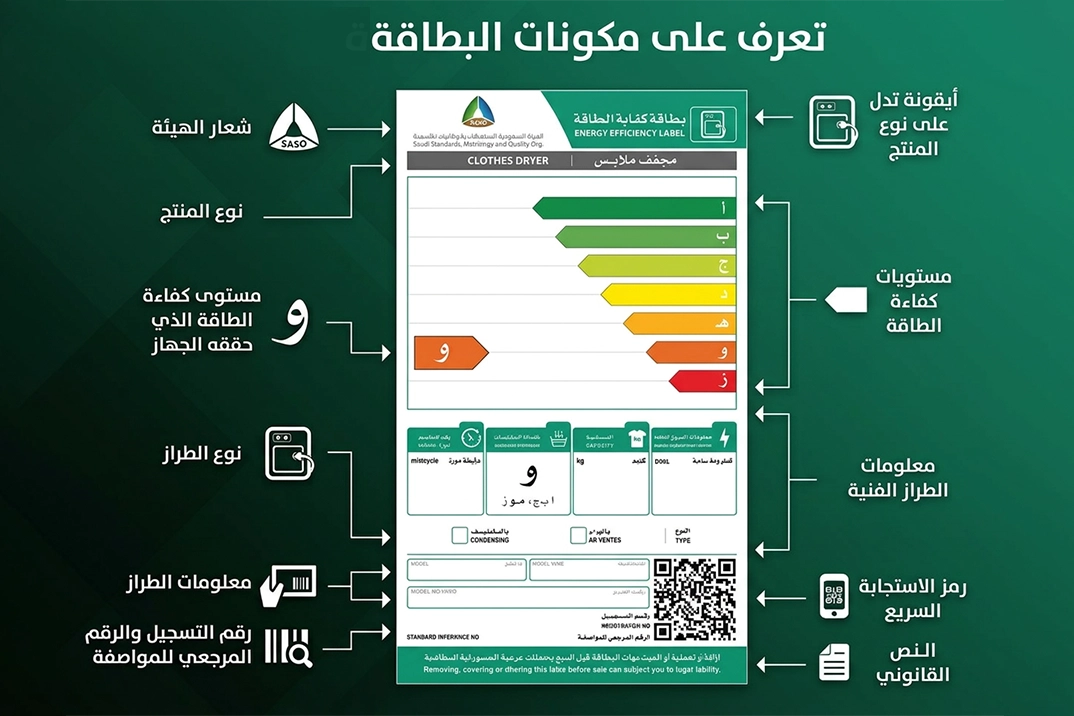
If you are comparing two devices and want to Energy Efficiency Label Explained In a practical way, the main idea is not to memorize all the codes and standards, but to know What to read first, what to compare to what. In Saudi Arabia, energy efficiency labels exist to help consumers before making a purchase, covering appliances such as air conditioners, refrigerators, and freezers. The format of the card has also been updated from the old star system to 7 levels of A to G To standardize reading and make it easier to compare between devices.
Why is the energy efficiency label important?
Because the card is not a sticker on the device, but a purchasing tool that helps you know Pre-payment energy efficiency level. SASO explains that efficiency labels are designed to enable the consumer to know the efficiency of the product and reduce energy consumption, which is why reading the label is an essential step before looking at the color, shape, or even some secondary specifications.
Before you start: 3 rules to get the card reading right
The first rule: Only compare devices from The category itself.
The second rule: In air conditioners, compare appliances that are close in Capacity and type.
Third rule: In refrigerators, compare appliances that are close in Size and design.
This point is very important, because the efficiency scorecard is used for fair comparison within the correct category, not between a small device and a much larger one.
The first thing you look at: the letter from A to G
In the current version of the Saudi card, the reading starts from Crafts Not from the stars.
Crafts A means higher efficiency, followed by Band then C.... even G which represents the least efficient level. This system was adopted to standardize the format of energy efficiency labels on household appliances and make them easier for consumers to understand.
Step-by-step explanation of the energy efficiency label for air conditioners
1) Make sure you are comparing similar air conditioners
Before reading any number on the air conditioner label, make sure you're not comparing Split 18000 For example, with a much larger or smaller device. The “To Stay” campaign shows comparisons between air conditioners of similar capacity to illustrate the difference in annual consumption between different efficiency levels, which is the correct use of the card.
2) Read the competency category first
For small capacity window and duct type air conditioners, the current Saudi card is based on the SASO 2663:2021While large capacity air conditioners are subject to the SASO 2874:2016. For common small home air conditioners, the current energy SEER and not on the old system based on EER only.
3) Next, go to the value of SEER
in Energy Efficiency Label Explained For air conditioners, the most important number after the letter is SEERor Seasonal Energy Efficiency Factor (SEEF). This indicator reflects the efficiency of an air conditioner across seasonal operating conditions, not just at a single point of operation, which is why SASO adopted it in the update of the small capacity air conditioner standard. The higher the SEER The device level was closer to AThe air conditioner was more energy efficient within its correct class.
4) What is the meaning of A وB وC in the AC card?
According to the classification SEER In the specification SASO 2663:2021:
Category A Start from SEER ≥ 18.0،
And the category B from 15.0 to less than 18.0،
And the category C from 12.5 to less than 15.0،
And the category D from 10.0 to less than 12.5،
And the category E from 9.0 to less than 10.0،
And the category F from 8.0 to less than 9.0،
As for G They are less than 8.0.
This doesn't mean to choose the highest category separately from capacity, but to use these categories to compare really close devices.
5) Pay attention to the approximate annual consumption of the air conditioner
An important piece of information on the air conditioner's label is that Annual energy consumption is an approximate value based on running the air conditioner 2700 hours per yearwhich is approximately 7 and a half hours a day. This point is important because some people read the number as actual consumption in all cases, when in fact it's an approximation for comparison between devices.
6) Don't separate the card from the room space
Even if the AC card is excellent, it won't give you the best result if it Inadequate capacity. “To Stay” explains that the appropriate capacity depends on the size of the room, the number of users, thermal insulation, and the nature of the consumption. So when reading the air conditioner's label, you should look at Efficiency + capacity for the space together, not to the letter alone.
Refrigerator Energy Efficiency Label explained step by step
1) Start with the letter, but don't stop there
In refrigerators and freezers, products are subject to the SASO 2892:2018and categorization has also become a A to G. But here the understanding is different from air conditioners: You're not looking for SEERIt's about Efficiency category based on EEIthat is, the energy efficiency index.
2) What is the meaning of A to G In the refrigerator card?
According to updates to the SASO 2892The classification of refrigerators and freezers is as follows:
A When it is EEI ≤ 50،
B When it is 50 < EEI ≤ 65،
C When it is 65 < EEI ≤ 80،
D When it is 80 < EEI ≤ 95،
E When it is 95 < EEI ≤ 110،
F When it is 110 < EEI ≤ 125،
وG When it is EEI > 125.
This simply means that the devices closest to the A More efficient than the devices closest to G inside the right comparison.
3) Why is the letter alone not enough in refrigerators?
Because evaluating refrigerators is inseparable from Total volume in liters. Updates SASO 2892 She explains that calculating the efficiency of refrigerators is related to elements such as Annual energy consumption (AEC)andTotal volumeandEnergy Efficiency Index (EEI). So it's not a fair comparison between a small refrigerator and a large family refrigerator just because they're both labeled with a particular letter. In refrigerators, size is part of the reading logic, not just a side detail.
4) The correct way to read the refrigerator label
If you want to Energy Efficiency Label Explained for refrigerators in practical terms, so read them in that order:
Start with the efficiency category, then look at Total volumeand then only compare with refrigerators that are close in capacity and design. This way the comparison is truly fair, because the refrigerator's label is based on a formula that links efficiency to size and consumption, not on the letter alone.
What is the practical difference between an air conditioner card and a refrigerator card?
The fundamental difference in Energy Efficiency Label Explained Here is that the AC card is based in the common household category on SEERWhile the refrigerator card is based on EEI.
In an air conditioner, your biggest focus is on:
Category Efficiency + Value SEER + Appliance capacity suitable for the location.
In the refrigerator, your focus is on:
Efficiency category + overall size + comparison within roughly the same size category.
Common mistakes when reading the card
The most common mistake is for the buyer to read the letter as a final judgment without context.
It is not appropriate to compare an air conditioner A Small capacity with air conditioner B much larger and immediately conclude that the former is “better” for all situations. It is not right to compare a very small refrigerator to a large family refrigerator based solely on the letter. Another mistake is to ignore the type of appliance itself; an air conditioner card doesn't read the same way as a refrigerator card.
How do you actually use the card during a purchase?
The smartest way is this:
- If you are comparing two conditioners Similar, start with the letter, then read SEERThen, make sure the capacity is suitable for the room.
- If you are comparing Two refrigeratorsStart with the letter as well, but don't make the decision before looking at the Total volume and make sure that the comparison is between two categories that are really close.
- If you want to validate card information or compare similar products, you can use Confirm application which allows you to check the energy efficiency labels of air conditioners and refrigerators and compare similar products.
Conclusion
The best way to understand Energy Efficiency Label Explained is to treat it as a smart comparison tool, not a cosmetic label.
Start with the letter A to Gand then read the appropriate indicator for the device itself:
In air conditioners, focus on SEER and the appropriate capacity of the space.
In refrigerators, focus on Efficiency class with total volume،
Only compare appliances that are as similar as possible. This way, the energy efficiency label becomes an actual part of the purchasing decision, not just a piece of paper on the appliance
